Sunspot Region 4551 lifts 10 and 12 meters into DX shape
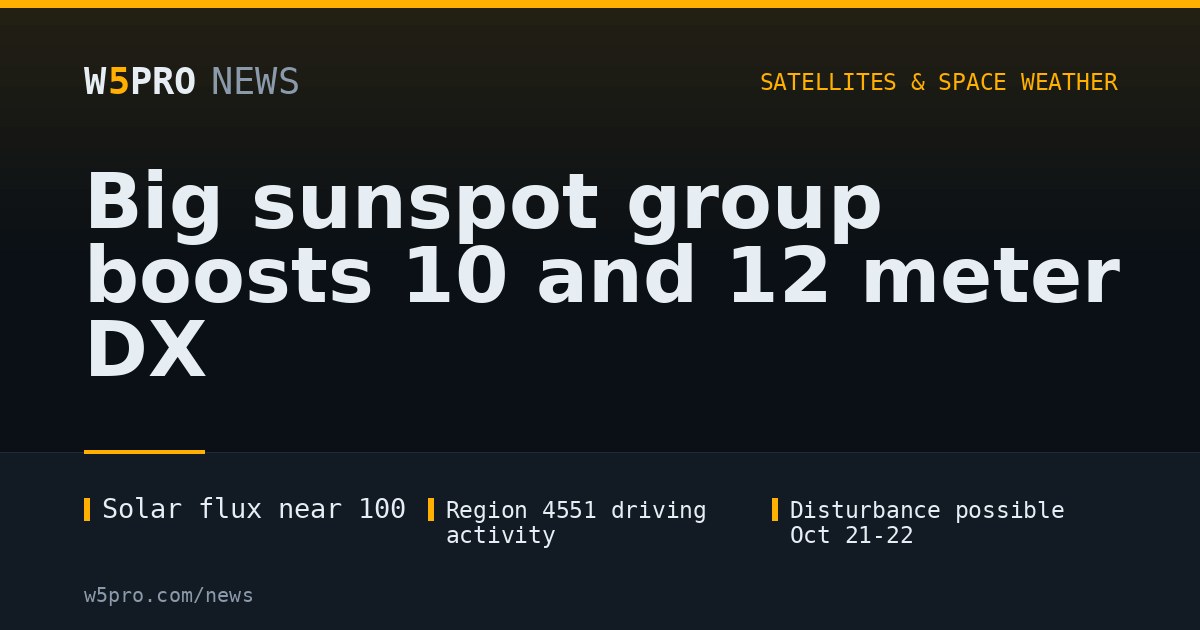
Ten and 12 meters are worth a fresh look this week. Solar flux and sunspot numbers are sitting at or above 100, and the W3LPL Propagation Forecast from the Daily DX expects significantly better DX on those two bands for as long as the next 10 days, with excellent conditions also forecast on 20, 17 and 15 meters.
NOAA's Space Weather Prediction Center credits much of the rise to sunspot Region 4551, which it calls the largest and most complex of the six regions now visible on the Sun. The 10.7 centimeter solar flux is a standard measure of solar activity, and higher values generally mean a more strongly ionized upper atmosphere that can bend the shorter HF wavelengths back to Earth for long-distance contacts. The Australian Space Weather Forecasting Centre expects mostly normal HF conditions worldwide.
Not every forecaster sees the good news lasting. In his weekly commentary dated October 15, F. K. Janda, OK1HH, noted that the most recent flux peak of 136 on October 13 came exactly 27 days, one solar rotation, after September 17, when a long stretch of readings below 100 began. He expects solar activity to decline for the rest of October, though he also anticipates relatively calm and favorable conditions after a short geomagnetic disturbance following October 20.
The official outlook for October 16 to 22 puts the predicted planetary A index at 5 for the first five days, then 15 and 20, with the K index climbing from 2 to 3 and then 4 at the end of the period. Predicted solar flux ranges from 95 to 105, averaging 99.3. Rising A and K values signal a disturbed magnetic field, which tends to degrade HF paths, especially at high latitudes.
For operators, the W3LPL forecast suggests working the higher bands while the sun is up, then following the openings down the spectrum: 30 meters opening to DX in the late afternoon, 40 meters about an hour before sunset, and 80 meters just after sunset. Plan the best upper-band operating for the quiet days before October 21, since conditions may get rougher late in the week.
Source: ARRL, October 16, 2026. Rewritten for W5PRO News; see the original for full details.